
Wine and the Moon: Does Lunar Timing Really Matter?
I caught up with a friend earlier, and we had a fascinating conversation about astrology—something I’ve always had a soft spot for. Especially after all the hype about the Blood Moon during the lunar eclipse, it got me thinking about the moon and its impact on wine, a concept I hadn't considered for some time. Yet, the moon plays a crucial role in viticulture, influencing key vineyard activities such as pruning and harvest, as well as (for many) the best times for wine tasting.
The idea isn’t rocket science (ba dum tss). The moon’s gravitational pull affects the biological rhythms of many organisms—just ask any woman! It influences development, reproduction, and even migration patterns. The lunar calendar, which considers both the moon’s phases and its transition through different constellations, serves as a guide for biodynamic agriculture.
The Science Behind It
Rudolf Steiner first introduced the concept of biodynamics in the 1920s, which was later expanded upon by Maria Thun in the 1960s. She developed a calendar indicating the best days for tasting wine—a theory further refined by her son, who authored When Wine Tastes Best, later transformed into an app.
The principle suggests that not only do plants respond to the positions of the moon, sun, and planets, but that we can optimise various aspects of winemaking by considering these celestial alignments. For example:
Earth constellations focus a plant’s energy on its roots, making these ideal days for pruning.
Fire constellations direct energy towards fruit-bearing, making them prime harvesting days.
How It Affects Wine Tasting
The lunar calendar also suggests that wine can taste different depending on the day you drink it. Here are the basics:
Fruit Days: Wines are at their most expressive, showcasing a full range of aromas and flavours. These are the best days for wine tastings or enjoying a special bottle.
Flower Days: Wines highlight their delicate floral notes, making these days ideal for appreciating aromatic white wines and elegant reds.
Leaf Days: Wines may exhibit more vegetal and herbaceous qualities, which can be intriguing but might not be ideal for your finest bottles.
Root Days: Wines often taste more subdued, with heightened tannins and earthy notes. Generally considered the least favourable for tasting.
Node Days: Occurring when the moon crosses the Earth’s orbit, these are typically days when wines are more ‘closed’ and less expressive.
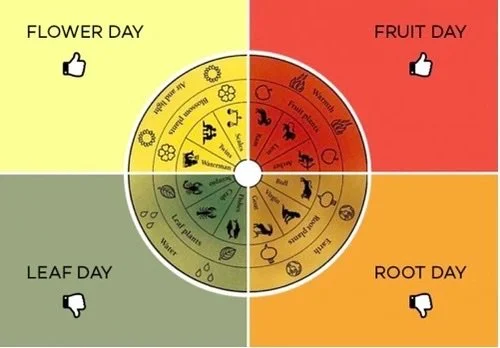
For visual learners, we love this quadrant designed by Wine Folly, featured in their article "Biodynamic Calendar & Fruit Day Wine Tasting"
But Does It Really Work?
Like many of life’s big existential questions, this is a matter of personal belief. Some people swear by it, while others dismiss it outright. For the scientifically minded among you, a study conducted in 2016 in New Zealand involved a blind tasting of Pinot Noirs on different days of the lunar calendar. The results concluded that there was no strong evidence to support the idea that the lunar cycle significantly affects wine taste. You can read the full study here. We think that the only way to know for yourself is to give it a go! We recommend trying the When Wine Tastes Best app to track the best days for wine tasting and see if you notice a difference.
Want to Learn More?
Of course, the complexities of biodynamics and astrology can’t be fully explored in one short piece. But we hope you found this introduction interesting! If you’d like further reading recommendations, feel free to get in touch on info@handpickedspanishwines.com
